Gravel Pad Installation Services in Bowling Green, OH
Gravel Pad Installation Kings provides gravel pad installation, gravel shed foundations, and gravel pads for hot tubs, RVs, and equipment in the Bowling Green, OH area for both residential and commercial properties. Contact us now for a free estimate.
How Much Does Gravel Pad Installation Cost in Bowling Green, OH?
Gravel pad installation in Bowling Green, OH costs anywhere from $700 to $1,800 on average for a framed shed pad of about 12x14 to 14x18 feet. The price depends on the pad size and depth, the timber frame and fabric, how far the ground is off level, the soil, stumps or roots, equipment access, and hauling away the dug soil.
Do You Build Gravel Pads for Homes, Farms, and Businesses?
Yes, we build gravel pads for houses, farms, and commercial properties. Tell us what the pad will hold and roughly how big it needs to be.
Do You Service My Area?
Yes, we cover the Bowling Green, OH area. Send us the property address and we'll confirm.
How Soon Can You Build My Gravel Pad?
We can usually give you a date when we quote, and it depends on the season and our schedule. Digging waits until 811 has marked the buried utilities, which usually takes a few working days.
Should the Pad Be Finished Before My Shed Is Delivered?
Yes, the pad has to be built, leveled, and compacted before the shed arrives. Give us your delivery date and the dealer's site requirements so we can book the work ahead of it.
What Information Do You Need for a Gravel Pad Quote?
We need the address, the size of the shed or whatever the pad will hold, and photos of the spot showing slope, trees, and the route in. Mention stumps, rock, wet ground, and how far you are from the property line.
Will I Need to Be Home While You Build the Pad?
No, as long as we can get equipment to the spot and you've approved the location. It helps to be there when we stake the corners so the placement is exactly where you want it.
Do I Need a Permit for a Gravel Pad?
No, usually not for the pad alone, but the shed or garage on it may need one, and setbacks from property lines still apply. Your local building or zoning office decides, so check before we stake it out.
Do I Need HOA Approval Before You Build a Shed Pad?
Yes, if your HOA reviews sheds or outbuildings, which many do. Get approval for the shed and its location first, since the pad goes exactly where the shed will sit.
Can I Get a Price Before the Work Begins?
Yes, we confirm the price before starting. If we dig into a buried stump, rock, or old concrete, we stop and talk to you before doing extra work.
How Long Does It Take to Build a Gravel Pad?
We finish most shed and hot tub pads in less than a day. Steep slopes, large garage pads, and sites where everything moves by wheelbarrow can take longer.
How Big Should a Gravel Pad Be for My Shed?
We build it about 12 inches larger than the shed on every side, so an 8x12 shed sits on a 10x14 pad. The border keeps roof runoff from washing out the edges.
How Deep Should a Gravel Pad Be?
At least 4 inches of compacted stone, usually 4 to 6 inches.
What Kind of Gravel Do You Use for a Shed Pad?
We use 3/4 inch clean crushed stone, sometimes sold as #57 or washed stone. The sharp edges lock together when compacted, and the open spaces let water drain away from the shed floor.
Can You Use Pea Gravel or River Rock for the Pad?
No, not for the base. Round stone rolls under weight and never locks, so the pad shifts. Pea gravel can go on top of a crushed stone base for looks.
How Many Tons of Gravel Does a Shed Pad Take?
A 12x14 pad at 6 inches deep takes about 4.5 tons of stone, and a 14x20 pad about 7.3 tons. We work out the tonnage from your shed size and include it in the quote.
Do You Build a Timber Frame Around the Gravel Pad?
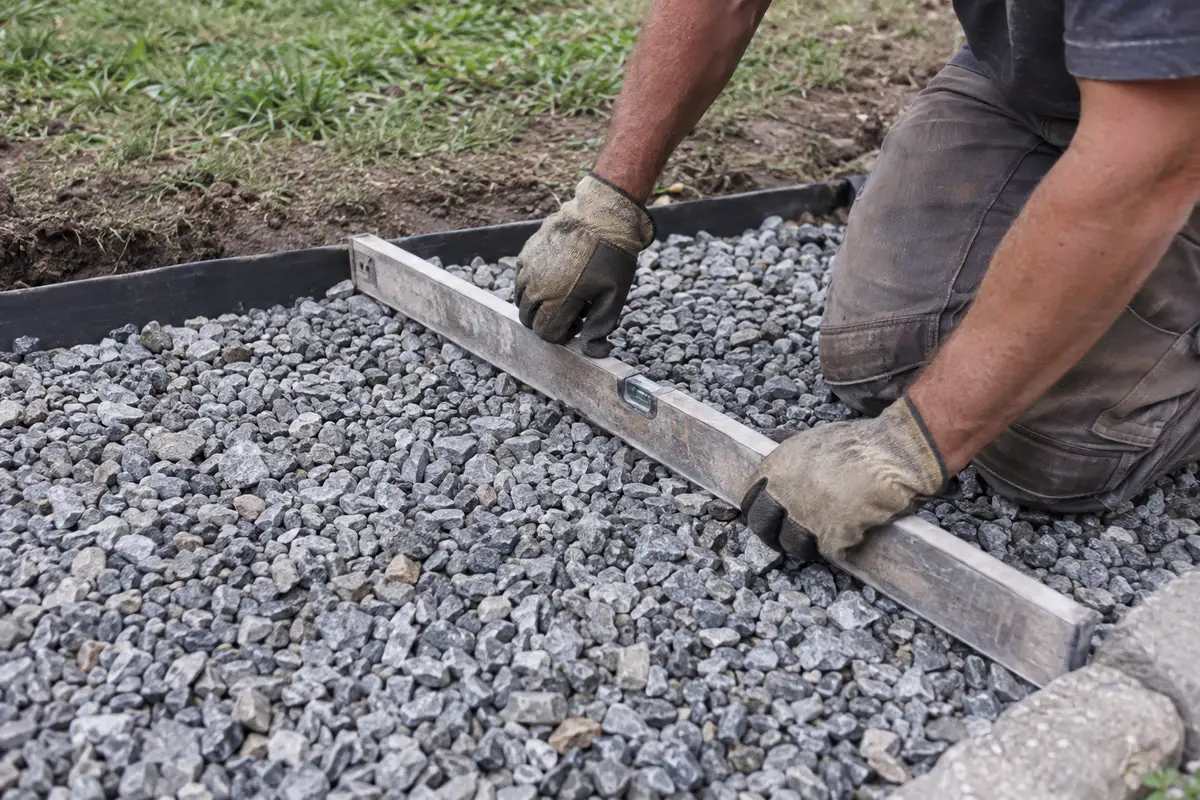
Yes, on most shed and hot tub pads. We use ground-contact pressure-treated 4x6 lumber staked with rebar, and stack extra rows on the low side of a sloped yard.
Do You Put Landscape Fabric Under the Gravel?
Yes, we lay a woven stabilization fabric under the stone. It keeps the gravel from sinking into the soil and cuts down on weeds coming through.
Can You Build a Gravel Pad for a Hot Tub?
Yes, a filled tub weighs about 2,000 to 6,000 pounds and our framed, compacted stone pads carry that well. Check that your tub maker accepts a gravel base under its warranty.
Can You Put an Inflatable Hot Tub on a Gravel Pad?
Yes, with a spa mat or flat pavers on top so stones can't puncture it.
Can You Build a Gravel Pad for an RV or Camper?
Yes, we build RV pads with a thicker compacted base, often 6 to 8 inches, graded so water runs off. A 12x40 foot pad typically takes about 10 to 15 tons of stone.
Can You Build a Gravel Parking Pad Beside My Driveway?
Yes, we build parking pads for cars, boats, and trailers. Tell us what will park there and how it will get on and off the pad.
Can You Build a Gravel Pad for a Prefab Garage or Large Shed?
Yes, a 24x24 garage needs a pad of about 26x26 feet and roughly 17 tons of stone, so we need a truck route close to the spot. Check whether your garage maker or town requires concrete or frost footings.
Can You Build a Gravel Pad for a Horse Barn or Run-In Shed?
Yes, horse barn pads usually use stone dust instead of 3/4 inch crushed stone. Larger barns may need concrete footers to carry the building, so send us the barn size.
Can You Build a Gravel Pad for a Generator or Pool Equipment?
Yes, a compacted gravel pad suits most home and small business generators, pool pumps, and filters. Industrial generators may need concrete, so send us the model and the maker's pad requirements.
Can You Put a Gravel Pad Under an Above-Ground Pool?
Yes, as long as a pool pad goes between the liner and the gravel to prevent punctures. Give us the pool diameter so we can size and level the base.
Can You Build a Gravel Pad for a Gazebo?
Yes, gravel makes a good gazebo base because it drains water away from the posts and floor.
Can You Build a Gravel Pad on a Sloped Yard?
Yes, we cut into the high side and build up the low side with stacked timbers, so the top of the pad is level. Tell us roughly how many inches the ground drops across the spot.
Does a Sloped Yard Cost More for a Gravel Pad?
Yes, usually. A site more than about 8 inches off level takes extra digging, lumber, and stone, and that can add 20% to 40% to the price.
Can You Build a Gravel Pad on Soft or Wet Ground?
Yes, we dig deeper, lay fabric, and use a thicker base, sometimes up to 8 inches. If water sits there after rain, we may suggest moving the pad to higher ground.
Can You Build a Pad Where There Are Stumps or Tree Roots?
Yes, but stumps and large roots under the pad have to come out or be ground down first, because they rot and leave soft spots. Let us know about them when you send photos.
Can You Get Equipment Into a Fenced Backyard?
Yes, in most cases, since compact skid steers fit through many gates. Tell us the gate width. A narrow gate or a long route means hand work, which adds time.
Do I Need to Call 811 Before You Dig?
No, we request the 811 locate before we dig. It marks public gas, power, water, and cable lines, but not private ones like sprinklers, so point those out to us.
Should I Clear the Area Before You Arrive?
Yes, move anything sitting on the spot, like an old shed, firewood, or toys. We handle removing the sod and topsoil as part of the job.
Can You Build a Gravel Pad in Winter or Rain?
Yes, in most weather, but not on frozen ground or in soil turned to mud. Heavy rain can push the job back a day or two.
Is a Gravel Pad Better Than Concrete for a Shed?
Yes, for a shed with a wood floor. Gravel drains away from the floor framing and usually costs a third to half as much. We suggest concrete for a shed with no built-in floor.
Is a Gravel Pad Better Than Shed Foundation Blocks?
Yes, in most cases. Blocks hold the shed at a few points and can settle unevenly, while a gravel pad supports the full length of the floor runners.
Can I Build a Gravel Pad Myself?
Yes, a small level pad is a fair DIY project with a rented plate compactor. Most people call us for slopes, large pads, or several tons of stone to move by wheelbarrow.
Will a Gravel Pad Need Maintenance Later?
Yes, a little. Parking pads may need a top-up of stone every few years, typically $100 to $400. A framed shed pad that was compacted well usually needs very little.
Can You Fix or Re-Level an Existing Gravel Pad?
Yes, we can add stone, re-compact, and replace rotted frame timbers. If a shed already sits on it, tell us how far it is out of level and whether the shed can be lifted or moved.
Do You Haul Away the Soil You Dig Out?
Yes, we can haul it off or spread it elsewhere on your property. Haul-away is usually priced separately, so tell us which you want.
